🚀 Speed up implementation with hands-on, face-to-face training from the developer. 💬 Join the Jube WhatsApp Public Support Group to chat with the developer.
Local Least Recently Used (LRU) Cache
As introduced in the architecture section of this documentation, the real-time performance of the platform is in large part owing to the use of a Remote Key Value \ Data Structure Pair data store, in the form of Redis (although these days it implies any RESP protocol). In many cases the centralization of and the serialized access to this data are extremely important, especially in maintaining the latest transaction ledgers, so that irrespective of the node processing the transaction, the transaction order is preserved.
Referencing the Cache Schema documentation, it can be noted that one of the Payload prefixes contains data referenced intensely, and to a degree inefficiently, with the trade being no duplication of Payload storage for the ledgers. For example, consider a search key that has a limit of 100 records, and consider that there might be four of them; for each transaction stored in the ledger the payload will need to be recalled from Redis, and while Jube manages this process across to ensure there is no duplication of Payload requests, it remains a significant and inefficient request volume for Redis, and significant transport overhead.
Jube is quite compute intensive given the level of task parallelism that happens during transaction processing. Assuming that Jube is configured using compute from one of the hyperscalers (e.g., AWS, Azure, Digital Ocean),
this may well create a situation where to compute provisioned (i.e., Virtual Machine) has a large amount of redundant memory.
Meanwhile, for Redis, given the load that Payload matching causes on the Redis Server, and that running cost of Redis in practice, Redis is substantially and inefficiently overallocated.
To improve performance, achieve better memory server density and better Redis allocation, Jube maintains a local Least Recently (LRU) cache of the Payload prefix data. During transaction processing, for Payload prefix data referencing, the local LRU cache is attempted, and Redis is used only in case of a cache miss. Serialization schemas are common in both the local LRU cache and Redis, being optimised MessagePack binary serialization, and it followed that deserialization overhead is unaffected given local or remote Payload recall.
Given the total availability of Payload prefix data in the local LRU cache, a fourfold improvement in transaction throughput can be achieved.
The local LRU cache can evict Payload prefix data given the total size of the local LRU cache exceeding a value set in the LocalCacheBytes environment variable. It is oftentimes possible to maintain all Payload prefix data in the local cache, however, even partial cache hits, there remains significant performance improvement given a significant proportion of load being offloaded to the local LRU cache. Given that the local LRU cache is on the basis of least recently used eviction, it affords a better than proportional reduction in a Redis load.
The local LRU cache is enabled by default for 1GB but is subject to the LocalCache environment variable.
The LocalCacheFill environment variable determines if on Jube startup if the local cache should be filled from Redis with a hash scan, and is the default. In the event that fill is disabled, it will allow a faster startup, but at the expense of increased pressure on Redis, and is henceforth discouraged.
Given an arrangement of Jube in a clustered and highly available manner, it is incumbent to update all Jube instances local LRU caches. Subject to the RedisPublishSubscribeEvents environment variable, events are published on the addition, update, and deletion to the local LRU cache., Distributed instances of Jube are subscribed to the events, updating its local LRU cache to maintain parity between all instances. Events are published using the Redis Publish\Subscribe functionality, based on the following structure:
| Prefix | Type | Key Structure | Value |
|---|---|---|---|
| HashSet | Create | HashSet:Server:InstanceCorrelationGuid:PayloadKey:HashSetKey | MessagePack serialisation of payload |
| HashRemove | Remove | HashRemove:Server:InstanceCorrelationGuid:PayloadKey:HashSetKey | None |
A shortcoming of the Redis Publish\Subscribe functionality is that it can’t discriminate where events have originated from itself. Henceforth, the Server and InstanceCorrelationGuid combination that created the event - which by implication will already maintain an up-to-date local LRU cache - will be subscribed, potentially creating a recursion. On receipt of events, the Server and InstanceCorrelationGuid are compared. Server and InstanceCorrelationGuid definitively Server and InstanceCorrelationGuid definitively identify the event’s source. Given own source, then it will not update the local LRU cache, and it will be completely ignored.
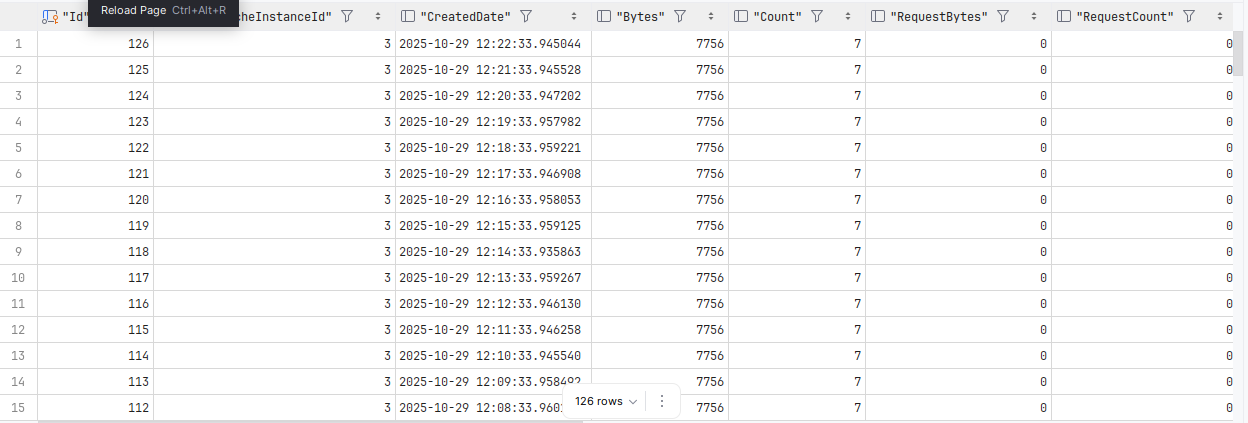
Given the significant effect the local LRU cache can have on overall performance, observability is provided via three Postgres tables that are updated every minute:
| Table | Description |
|---|---|
| LocalCacheInstance | The total bytes and payloads stored in the local LRU cache, the .Net memory pressure and details on the status of a fill (updated for each 100k filled). |
| LocalCacheInstanceKey | For a given Redis Key, the number and bytes of requests, misses, Hash Set subscriptions received and Hash Removal Subscription received. Includes , Redis response time on miss and deserialization times. |
| LocalCacheInstanceLru | For the local LRU cache, the total bytes and payloads available, the number, and bytes, of requests, updates, additions, removals and eviction. |
For example, for the LocalCacheInstanceLru table:
select *
from "LocalCacheInstanceLru"
order by 1 desc
The local LRU cache shares the same compression schema as Redis, subject to the RedisMessagePackCompression environment variable.