🚀 Speed up implementation with hands-on, face-to-face training from the developer. 💬 Join the Jube WhatsApp Public Support Group to chat with the developer.
HTTP API Asynchronous Model Invocation
Most of the procedures in this documentation makes use of synchronous HTTP requests in which the request is blocked for the client unitil absolute conclusion of the processing, notwithstanding a significant amount of asynchronous processing taking place in the processing to ensure reasonable response time by eliminating blocking waits on IO.
As the HTTP requests are handled by the Kestrel web server embedded into Jube, this translates to a request being made of a Thread from the .Net managed Thread Pool.
The .Net Thread Pool is perfect at sizing itself, however in periods of burst, thread load or saturation can occur, which may lead to inconsistent - yet not necessarily unreasonable - response times. The manageability and maintainability of the application becomes difficult should unmarshalled requests be made of the thread pool, especially in burst. Henceforth, as a philosophy, it is a preferred approach to queue work on in the instances internal concurrent queues and manually size thread counts, having detailed knowledge of the underlying hardware infrastructure. A further benefit of the manual thread sizing approach is to allow for asynchronicity in the client integration, without having to relying on asynchronous methods and thread pools client side, which may bring about many of the same challenges that this architecture sets out to solve.
There exists a switch in the model invocation endpoint which will instruct the asynchronous processing of a transaction or event:
https://localhost:5001/api/invoke/EntityAnalysisModel/90c425fd-101a-420b-91d1-cb7a24a969cc
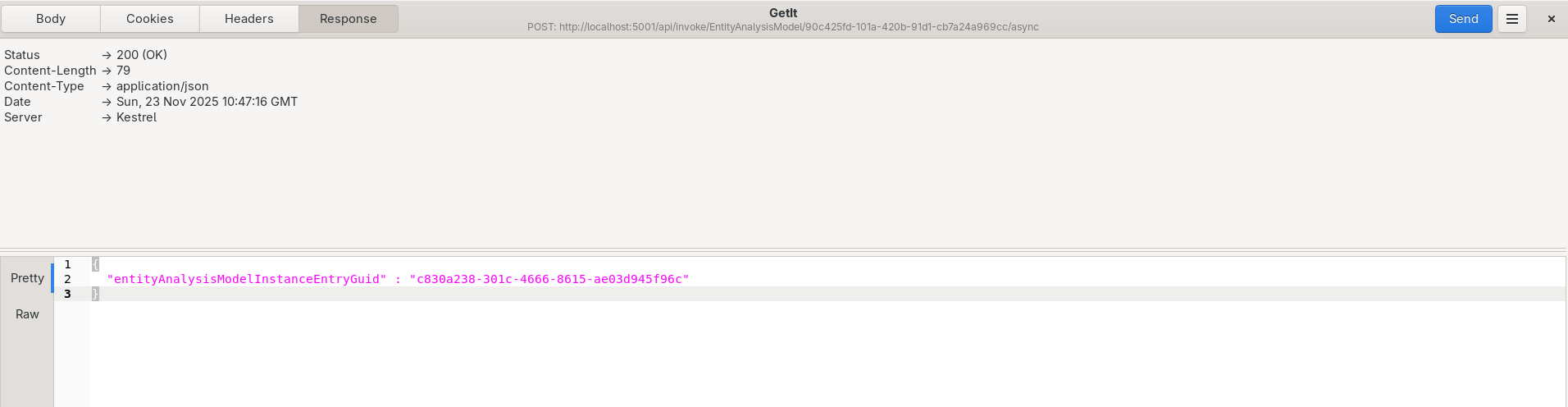
By adding the Async switch to the endpoint url the request payload is only processed up to the conclusion of Request XPath, after which the remainder of the processing is instructed via internal asynchronous queue, with a partial response payload being returned by HTTP. There are a predefined number of threads available for the remaining model invocation, specified as an Environment Variable called ModelInvokeAsynchronousThreads:
ModelInvokeAsynchronousThreads=1
In the event of burst, or incorrectly sized thread instantiations given available compute and load, then the queue will backup. The queue balance can be monitored via select:
select * from "EntityAnalysisModelAsynchronousQueueBalance"
Returning the following data:

Queue balances are captured roughly evey minute. In burst, queues backing up are to be expected, and will clear assuming that the threads are sized slightly ahead of demand.
The response payload can be called back via the invocation of the GET HTTP method Callback HTTP endpoint using the entityAnalysisModelInstanceEntryGuid element value taken from the initial HTTP response as key:
https://localhost:5001/api/invoke/EntityAnalysisModel/Callback/de1119dc-dda0-4916-a716-bbd39c69a17e
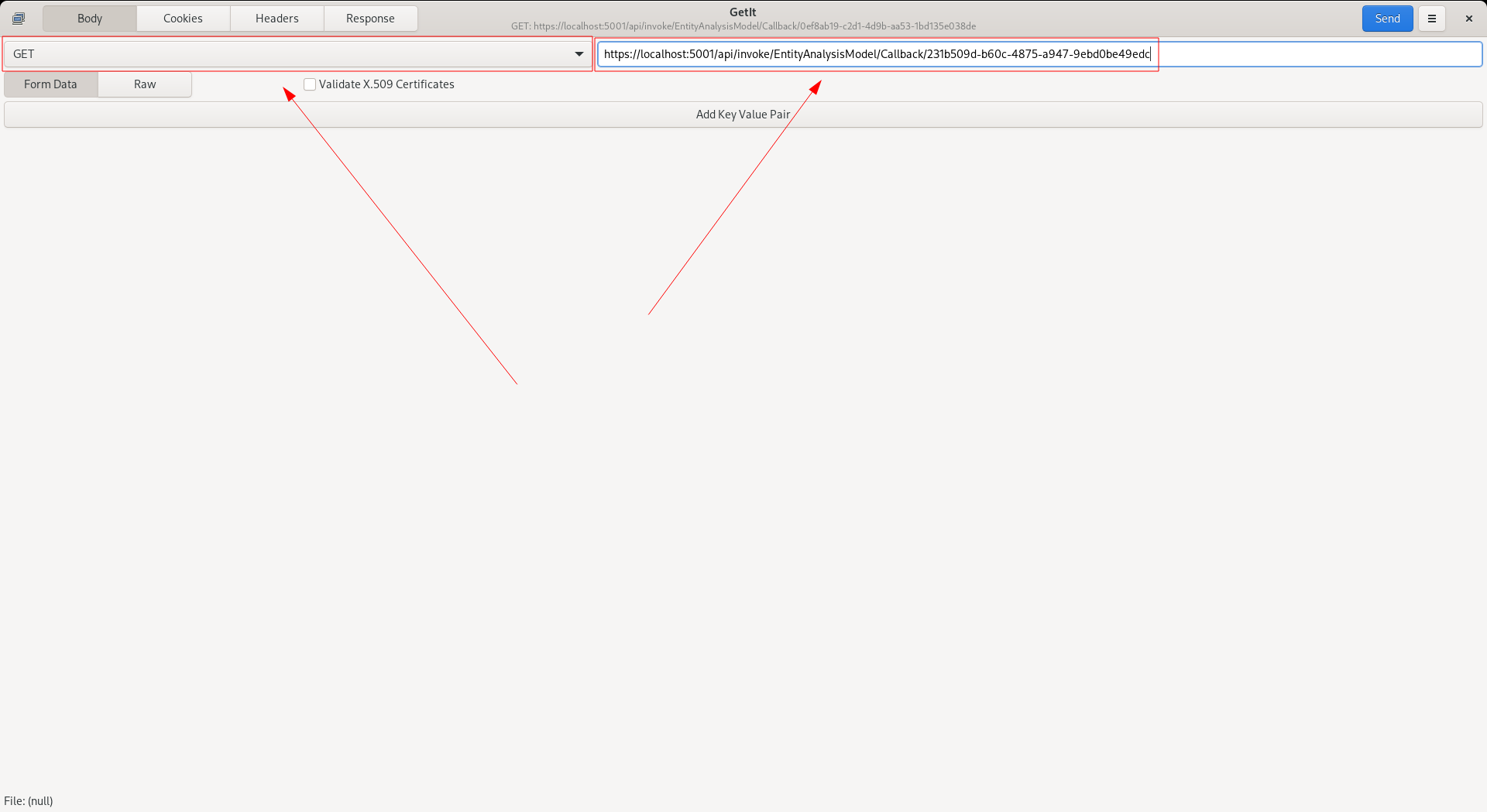
The response payload will be identical to that returned synchronously having been stored in an instance buffer once it is complete, and communicated via notification to other running instances. The default timeout is three seconds which implies that should background processing not have concluded, and made available within thirty seconds, a HTTP status 408 will be returned. The presence of timeouts would imply that that the threads are not handling burst adequately and not able to reach requests within tolerance.
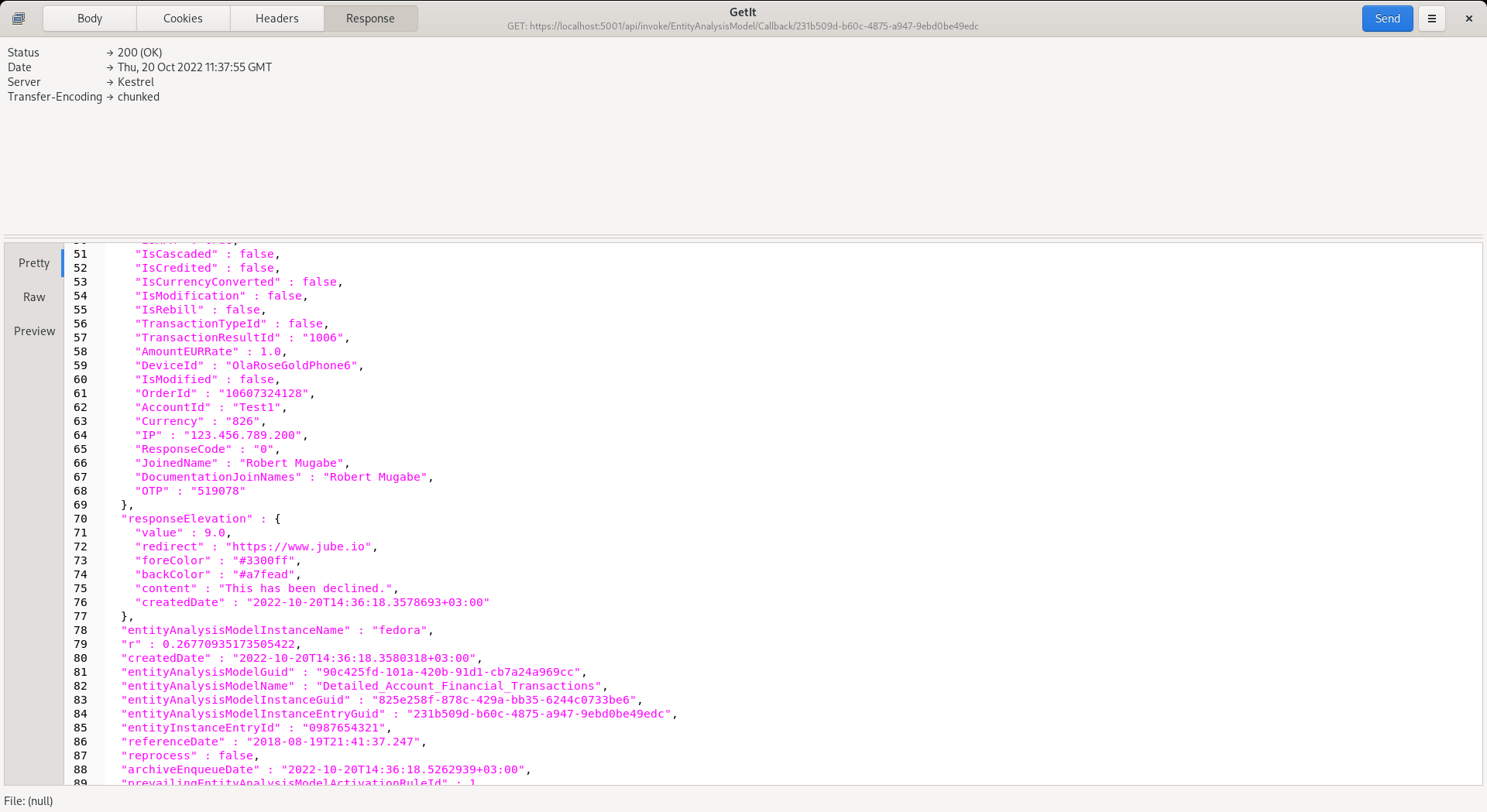
A callback may only be made once, as the callback is deleted upon matching EntityAnalysisModelInstanceEntryGuid value.
To enable HTTP callbacks, it is necessary to set the EnableCallback and CallbackTimeout Jube Environment Variables:
EnableCallback=True
CallbackTimeout=3000
There exists cluster wide publishing of callback Create and Delete events to facilitate effective continued load balancing. The full response payload is stored in the instance memory, duplicated by however many instances are configured for callback, which is the main rational for both Create and Delete events, allowing for the releasing of the memory across all instances just as soon as the Callback has been collected.
Given the potential for memory saturation on orphaned callbacks, in the event that a callback has not been collected, it will be removed upon the timout interval having been realised, configured in milliseconds in the CallbackTimeout Environment Variable. Monitoring for timeouts is achieved by polling the “EntityAnalysisModelAsynchronousQueueBalance” table as above, as a timout counter is maintained for each Callback.